Showing posts with label Fiction. Show all posts

09/10/2010

// DATABANK - 'NEUROMANCER' [W. GIBSON, 1984]


When it comes to envisioning the future, those individuals who are free to dream quite often make the most farsighted prophets. It is in the arena of science fiction that the original vocabulary of a new virtual, digitised urbanity is to be found. Moreover, it has quite often provided a much more accurate depiction of possible urban futures, with authors acting as ‘cyber-prophets’, when compared with the scientific and architectural establishment. Science fiction literature, in particular cyberpunk, throughout the twentieth century, has acted as a very real catalyst in the technological pursuits of the real world; new concrete scientific developments which are arriving ever more quickly on the heels of phantasmal science fiction.

> Digital Dystopia
Quite possibly the most frequently cited example of a fictional urban condition becoming increasingly relevant in the studies of contemporary society is that of the science fiction classic ‘Neuromancer’, by William Gibson. This seminal book was the novel that first coined the term ‘cyberspace’ back in 1984, as well as, rather prophetically, the concept of the arrival of a fully digitally-mediated society. The phrase ‘cyberspace’ was used to describe a virtual construct, within which exists a parallel virtual world of limitless potential, unrestricted by the limitations of the physical world. Cyberterrorism, genetic violence, cybernetic engineering and a dystopian world dominated by a singular digital virtual construct, controlled by a malevolent and mechanically ruthless artificial intelligence, potentially a logical evolution of our own contemporary military-industrial complex; the novel foresees a subjugated human future increasingly fused with, and ultimately controlled by, technology – a digital dystopia and one with the machine taking primacy over the human. The entire novel sees Gibson describe this new digital dystopia; a dystopia laced with veiled warnings concerning the current technological trajectories of the information age.

> Cyberspace: An Urban Reality
The concept of a globally connected virtual construct, a network that is totally ubiquitous and pervasive, and one which controls the future trajectories of that society is a frighteningly similar concept to the condition which pervades contemporary society. Visually, Gibson likens ‘the Matrix’ to the city, which is not unusual given that the city itself is a hive of information and communication infrastructures, and the centre of the vast majority of all human activity. Clearly, he perceived the human future as an urban one, within a domain dominated by an oppressive, highly complex, cybernetic network of sentient technological agents. All of these themes have understandably found renewed resonance in the study of today’s current social climate of pervasive digital networks.

> A Warning from Cyberspace?
Undoubtedly Gibson’s ‘Matrix’ construct bears a startling resemblance to our own internet construct, although admittedly with a much more militant and oppressive intensity. Perhaps the ‘Matrix’ is the logical result of the development of the contemporary internet, foremost of our global digital networks? This may seem somewhat fanciful but when one considers the fact that the internet’s humble origins began as a military experiment with strategic communications networks, perhaps society should take note of Gibson’s warnings and take care when steering the future evolution of our global virtual networks. As with all technological development, the results can be helpful or hazardous – an excellent example would be that of the internal combustion engine, which provided mobility, and relatively reliable, cheap mechanical power, but also produced congestion, pollution and of course, the car crash. The question for the urban planner is ultimately; will the increasing virtualisation of urban metabolisms be helpful or hazardous to the evolution of the city?

// DATABANK - 'WE' [Y. ZAMYATIN, 1921]


Written in 1921 as a response to the Russian revolution of 1917, ‘We’ is generally recognised as the genesis point of the futuristic dystopia genre. It takes the totalitarian and conformative aspects of modern industrial society to an extreme conclusion, depicting a state that believes that free will and independent thought is the root of all unhappiness, and therefore all citizens' lives should be centrally controlled with mathematical precision based on a system of industrial efficiency. The novel is both a tragedy of a conflicted modern man struggling to conform within his society, as well as an account of the same said flawed utopia. Over the intervening decades since its original release, We has become alarmingly relevant once more, in our age of political and cultural upheaval.

> A Dystopian Urban Allegory?
The plot follows the main character, D-503, who is a mathematician and chief engineer working on the ‘Integral’ project, which involves the conquest of space by the One State, following its conquest of earth. Throughout the course of the novel he develops the ultimate evil, a soul, and begins a rebellious relationship with a woman, I-330. She, it transpires, is involved in a revolutionary group, the Mephi, who are working to overthrow the One State. Together they make numerous visits to the ‘Ancient House’ [the last remaining opaque structure] and over the Green Wall to gather support from the ‘outsiders’. As the novel reaches its climax, the rebellion is in full swing. A portion of the Green Wall has been destroyed and outsiders are streaming forth into the One State. In response, the One State sanctions the mandatory mass lobotomising of the population, the so-called ‘Great Operation’. The novel ends with the repeated mantra that there is no final revolution, human society will always, ultimately function like a human, and utopia, however well-intentioned, will always breed dystopia. The central issues of We could be assimilated by any member of contemporary society, especially considering the disenchantment with urban life that is prevalent in the modern city. Perhaps we should take heed from Zamyatin’s forewarning concerning a ruling caste’s attempts to remain in power through a heady mixture of coercion, psychological conditioning and architectural subjugation, and the possible ramifications when they begin to lose their grip over the individual.


> Architecture as Utopian Vehicle?                              
The One State’s ideology, represented by the Integral project, is often seen as corresponding to the ideal of a global communist state held by early Marxists, but it may be more broadly understood as a representation of the predisposition of all modernising, industrial societies toward empire and colonisation under the guise of civilising development for "primitive peoples”. This is, fundamentally, a materialist view that reduces society to physical laws and processes that can be comprehended and manipulated for utilitarian purposes. It was a world view that Zamyatin detested, and We embellishes this conflict between a free society and a mass-deception-controlled, industrialised societal order. 

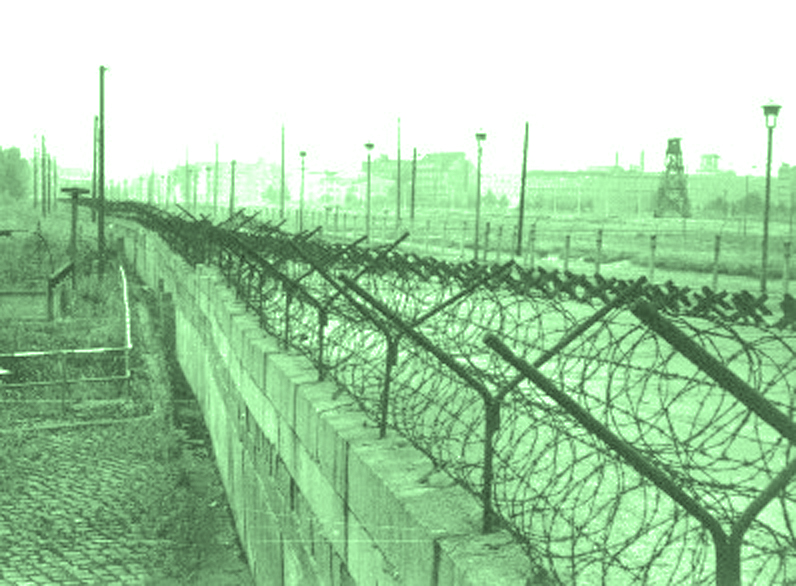
These themes have found increasing resonance within contemporary society. The Green Wall in particular has come to represent all manner of evils within our post-industrial age, namely the poverty, political and religious divides. The fact that this literary metaphor is architectural in nature speaks volumes of the present urban condition – one infected with mass segregation and division. Of course, these divides require a political solution first and foremost, but they will also eventually require an architectural manifestation, and our 'Green Walls' will ultimately need redesigning so that architecture can be mobilised as a vehicle for societal emancipation and egalitarianism rather than elitism and societal subjugation.

// DATABANK - '1984' [G. ORWELL, 1948]


1984 is one of the most intelligent and terrifying dystopias ever created; George Orwell's vision is probably the defining dystopia of the 20th Century. The novel depicts an oligarchical, collectivist, degenerated workers' state society where life exists in a world of perpetual war, pervasive government surveillance, & relentless public thought conditioning and control. The individual is always subordinated to the masses, and it is this philosophy which allows the political apparatus to manipulate, oppress and control humanity. The novel is an account of one man’s struggle to conform to, and desire to rebel against his society. Over the intervening decades since its original release, 1984 has become chillingly relevant once more, in our age of ubiquitous surveillance, and the rise of totalitarian ideologies with democratic overtures.


> Architecture as Dystopian Tool?
In 1984, society largely lives in poverty; hunger, disease, filth and social decrepitude are the norm and ruined cities represent the physical manifestation of the consequences of perpetual war and a totalitarian regime hell-bent on complete societal domination. When travelling through the urban environment, Orwell’s imagery is littered with rubble, social decay and wrecked buildings. The sole components of the city that received any architectural attention in the pursuit of the political agenda of Ingsoc where the four centres of power, the ministerial pyramids. Each building is described as being grand in scale, visually oppressive and as dominating the skyline completely. They are beacons of the total social and political dominance of Big Brother, and not only accommodate all functions of the Party, but also serve as a reminder to the citizens that the Party’s control is comparative to the pyramids’ dominance of the urban domain.


> Architecture: The Defender of Individual Urban Autonomy?
1984 has become alarmingly relevant in the 21st Century, not only in contemporary political and social discourse, but architectural and urban design discourse also. We are witnessing a real departure into the dystopian hell of Orwell’s masterpiece, with the modern city becoming a place of total control and ubiquitous surveillance, where public and individual freedoms are being curtailed at every street corner through a combination of political and corporate machinery. Perhaps, as urban designers, we should heed Orwell’s warning, and be prepared to defend the autonomy of the individual within the urban landscape, and pursue the democratisation of public space, and urban life as a whole, more rigorously.